
All case studies
Anonymized customer project
Case study from industrial robotics
From functional prototype to series production
A further 30% cost savings by switching from machining to die casting
A component from industrial robotics grew from 50 machined functional prototypes to a series quantity of 15,000 units. The biggest lever was a change of process.
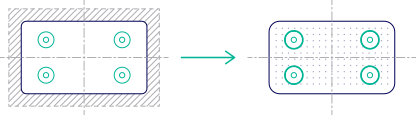
Series production doesn't start with the final design revision, but with the first prototype: with the question of future quantities.
Initial situation
A component from industrial robotics had to be available from the first functional prototypes onward, while the design and future series quantity were still open. The customer needed a partner for the entire journey: from 50 prototypes through a pilot series of 250 to a series demand of 15,000 units.
Objectives
- Functional prototypes available in small quantities
- Incorporate design changes without setting up the process from scratch
- Identify the point at which the manufacturing process becomes uneconomical
- Safeguard series supply against dependence on a single source
J&K's role
J&K remained the central procurement, quality and project partner throughout the entire program. Through the change of process and the qualification of additional partners, the customer's contact person never changed.
Solution
The early versions were produced by turning, milling and wire EDM. At 50 and 250 units, that is the right choice, because flexibility matters more than unit cost. At 15,000 units, the logic is reversed: the blank is cast and only the mating surfaces are finish-milled. Because the processes are coordinated through the network, the switch was a matter of calculation, not a change of supplier relationship.
From 50 to 15,000 units
-
Functional prototype
50 units
Turning, milling, wire EDM -
Pilot series
250 units
Machining retained -
Route re-evaluated
Machining or
casting depending on quantity -
Series quantity
15,000 units
Aluminum die casting -
Series ramp-up
3 months
production time -
Call-off
2 days
Warehouse in Germany
- Milestone
- Decision
- Intermediate step
Series supply without a single source
Customer
J&K CNC Technik
Central point of contact
- Partner 1 Production
- Partner 2 Alternative source
- Partner 3 Alternative source
Quality assurance
A first article inspection report, inspection plan and measurement program were delivered. In parallel, two additional manufacturing partners were formally qualified to the same inspection plan, so that series supply does not depend on a single source. Switching sources therefore does not mean switching standards.
Result
Switching to die-cast blanks delivered a further 30% on top of the price reduction that milling brings anyway at higher quantities, because only the mating surfaces still need finish machining. From series ramp-up onward, the annual demand is held in the J&K warehouse in Germany. Around four months before the framework expires, the next framework order is placed.
A further 30% savings:
die casting instead of machining
Unit cost at series quantity, index: machining = 100
-30 %
Conclusion
At 15,000 units, the problem wasn't the price, but the process itself. Only someone who keeps all processes in view can make a decision like this.
Services and materials used
FAQs
When should the manufacturing process be re-evaluated as quantities increase?
As soon as the planned production volume calls the cost-effectiveness of the original choice into question. In this case, the trigger was the move from a 250-piece pilot series to a production volume of 15,000.
Why die casting instead of continued machining?
At 15,000 units, the blank can be cast near-net-shape, so only the mating surfaces still need to be machined. This eliminates most of the material removal – and with it, most of the cost.
How does supply work during ongoing series production?
Series ramp-up takes around three months of production time. From then on, the annual demand is held in the J&K warehouse in Germany and called off within two working days; the next framework order is placed around four months before the current one expires.
Are plastics more difficult to machine than metal?
Different, not necessarily more difficult. Plastics expand more with temperature, can warp if machined incorrectly and require adapted tools and cutting parameters. Experience with the specific material is crucial — which is why we deliberately select suitable partners.
How is a second source set up for a series part?
Additional partners are qualified to the same inspection plan. In this program, two additional partners were formally qualified, so supply does not depend on a single source.
Is the 30% the total savings?
No. It is the additional reduction from the change of process, on top of the price reduction that machining brings anyway as quantities increase.
-
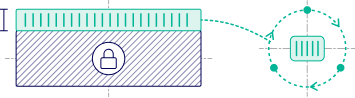
Schematic illustration
-
Schematic illustration 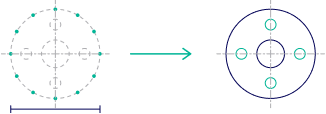
-
Schematic illustration 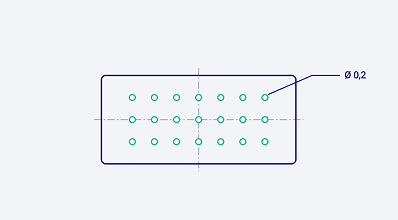
Planning a similar project?
Send us your drawing via GP-Digit and you will usually receive a binding quote on the next business day. Every inquiry is technically reviewed before a quote is prepared.