
All case studies
Anonymized customer project
CASE STUDY FROM Conveying and Handling Technology
Three iterations to the right coating
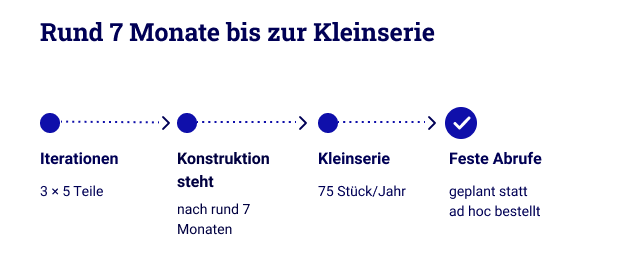
PU-coated transport shaft: from the first iteration to a small series in around seven months
An aluminum transport shaft where the challenge wasn't the turning, but the polyurethane coating.
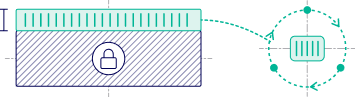
When the function lies in the coating rather than the geometry, iterating on the base body is wasted effort.
Initial situation
The customer needed a polyurethane-coated transport shaft. The turned aluminum base body was non-critical; the functional behavior depended almost entirely on the coating and its surface.
Objectives
- Find a PU coating that delivers the required friction behavior
- Test surface textures without setting up the part from scratch each time
- Transition from prototype iterations to a repeatable small series
- Secure fixed annual call-off orders as soon as the design is finalized
J&K's role
J&K coordinated turning and coating together through its network in every iteration, so that only the variable being tested changed with each trial, not the entire supply chain.
Solution
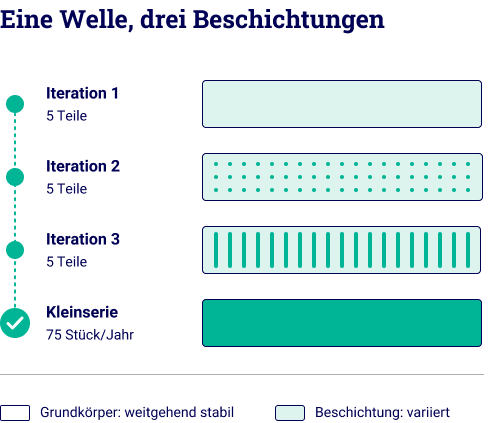
Three prototype iterations of five parts each were run. Both the PU formulation itself and a geometric surface texture to increase the coefficient of friction were varied. The basic geometry remained largely stable.
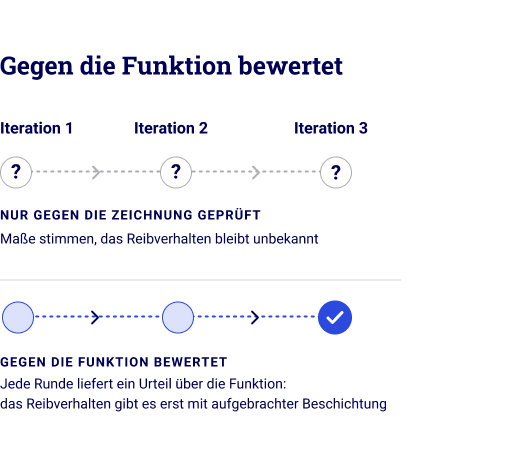
Because turning and coating were coordinated as one package rather than sourced separately, each iteration could be evaluated as a complete functional component instead of a base body plus unknowns.
Quality assurance
Each iteration was evaluated against the functional requirement, not just against the drawing, because the defining characteristic, friction behavior, only exists once the coating has been applied.
Result
After around seven months, the design was finalized and moved into a small series of 75 units per year with fixed call-off orders. The documented sequence from the iterations was carried over directly into series production instead of being rebuilt.
Conclusion
The geometry remained stable; only the coating and surface texture were varied.
Services and materials used
- CNC turning
- Aluminum
- Surface finishing
FAQs
Why did the project need three iterations?
The functional requirement lay in the coating, not in the geometry. Each iteration tested a different PU formulation and surface texture to achieve the required friction behavior.
Can turning and coating be sourced as one package?
Yes. In this project, both steps were coordinated through the network as one package, so each iteration could be evaluated as a finished functional component.
How was the coefficient of friction influenced?
Through the choice of PU formulation combined with a geometric surface texture on the coating.
How does a small series of this size work commercially?
In this case, through fixed annual call-off orders — 75 units per year, planned rather than ordered ad hoc.
-
Schematic illustration
-
Schematic illustration 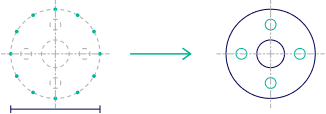
-
Schematic illustration 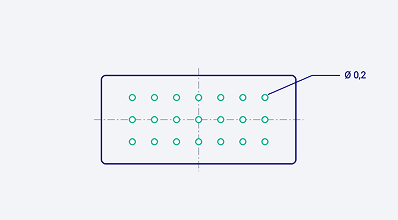
Planning a similar project?
Send us your drawing via GP-Digit and you will usually receive a binding quote on the next business day. Every inquiry is technically reviewed before a quote is prepared.