
All case studies
Anonymized customer project
CASE STUDY FROM Measurement and Testing Technology
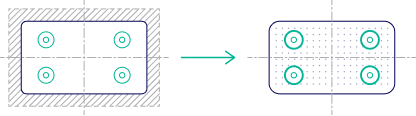
A housing with 0.2 mm bores — burr-free, in 904L stainless steel
SPC monitoring instead of final inspection, annual demand available for call-off within two working days
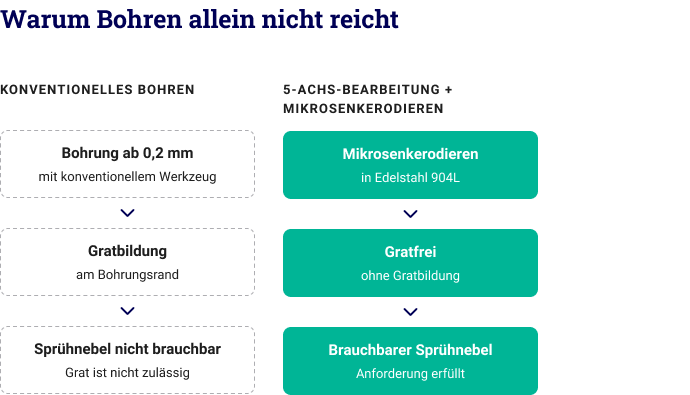
A housing for a fluid testing unit: the bores, starting at 0.2 mm, had to be completely burr-free to produce a spray mist.

At 0.2 mm, the question is no longer which machine can achieve the feature, but which process leaves no burr.
Initial situation
The customer needed a complex housing for a fluid testing unit. What mattered was not the overall geometry, but the smallest bores in the part at 0.2 mm, and the requirement that they be completely burr-free, because only then does the unit produce a usable spray mist.
Objectives
- Bores down to 0.2 mm in a highly corrosion-resistant stainless steel
- Completely burr-free bores as a function-critical feature
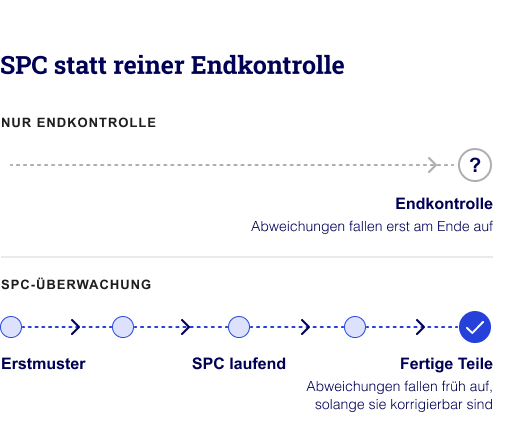
- Documented process reliability instead of final inspection alone
- Flexible availability across an annual demand of around 250 units
J&K's role
J&K reviewed the technical inquiry, selected a network partner able to combine 5-axis machining with micro die-sinking EDM, and set up the inspection concept and the stocking model for the annual framework.
Solution
The early versions were produced by turning, milling and wire EDM. At 50 and 250 units, that is the right choice, because flexibility matters more than unit cost. At 15,000 units, the logic is reversed: the blank is cast and only the mating surfaces are finish-milled. Because the processes are coordinated through the network, the switch was a matter of calculation, not a change of supplier relationship.
Quality assurance
A first article inspection report, inspection plan and measurement program were delivered. In parallel, two additional manufacturing partners were formally qualified to the same inspection plan, so that series supply does not depend on a single source. Switching sources therefore does not mean switching standards.
Result
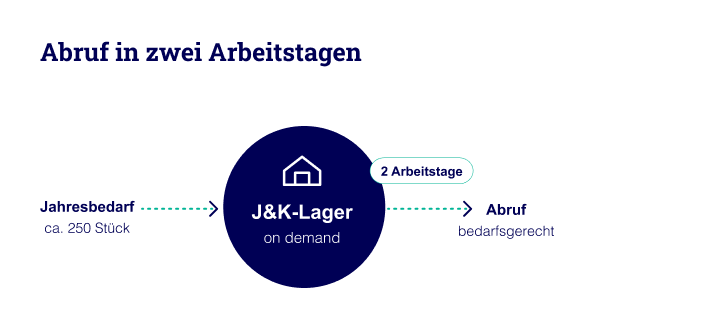
The customer reports a lower defect rate and more flexible production planning: the annual demand of around 250 units is held on demand in the J&K warehouse and can be called off within two working days — planning is therefore no longer tied to production lead time.
Conclusion
At 0.2 mm, the question is no longer which machine can achieve the feature, but which process leaves no burr. The combination of machining and micro-EDM solved a feature that no downstream inspection could have fixed.
Services and materials used
FAQs
How can 0.2 mm bores be produced reliably?
At this diameter, conventional drilling reaches its limits, especially when no burr is acceptable. In this project, the solution was 5-axis machining combined with micro die-sinking EDM, with the partner selected through the network specifically for this requirement.
Why 904L stainless steel?
904L (1.4539) is a highly corrosion-resistant austenitic steel, suited to the medium used in the testing unit. Accordingly, it is demanding to machine, especially with small feature sizes.
What does SPC mean in this context?
Statistical process control: the function-critical parameters are monitored during ongoing production rather than only inspected at the end, so deviations are detected while they can still be corrected.
How is availability secured across an annual demand?
The annual framework quantity is held in the J&K warehouse and called off as needed — in this project within two working days, which decouples the customer's production planning from the production lead time.
-
Schematic illustration
-
Schematic illustration 
-
Schematic illustration 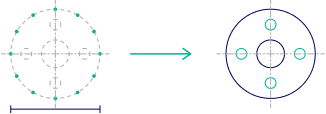
Planning a similar project?
Send us your drawing via GP-Digit and you will usually receive a binding quote on the next business day. Every inquiry is technically reviewed before a quote is prepared.